
CASE STUDY
Berry Superfos cut task management time by 90% with factory process digitalization
In 2016, every task handover at Berry Superfos’ Randers factory happened on paper. Shift managers distributed work manually at the start of each shift; employees filled in paper forms for every registration. With 25,000 tasks and registrations completed each year, the scale of the paperwork problem was considerable.
The factory chose Gluu to replace that paper-based system with a digital one. The goal was specific: allow managers to digitalize their own process flows, giving workers clear visual instructions on Android tablets and making task completion a single touch rather than a form-filling exercise.
Today, Berry Superfos runs all recurring tasks through Gluu. Processes are mapped in a shared value chain hierarchy, instructions come with images and video, and paper forms have been recreated as shorter, smarter digital equivalents. Workers confirm task completion with a single touch; data flows directly into the system without transcription.
The results are concrete: 90% time savings on managing tasks and forms, and employee involvement in process improvement rising from 10% to 90%. The factory now has one common standard for all recurring work — and one place to go when someone needs to know how a job is done.
“We see big-time savings by not having to handle our record keeping on paper anymore. Our registrations happen inside the app now.”
Jakob Lund
Former factory manager, Superfos Randers
Time savings
90
%
Time saved managing tasks and forms
Reported by Berry Superfos management after full deployment
Involvement
90
%
Employee involvement in process improvement, up from just 10%
Annual tasks
25,000
Tasks and registrations completed digitally each year
Replacing paper forms and manual handovers across all three shifts
The problem with paper-based factory management
In 2016, all registrations at Berry Superfos’ Randers factory were completed on paper. Shift managers delegated tasks manually at the start of each shift. The quality management software in use handled document maintenance — nothing beyond that. There was no digital layer for task execution or on-the-floor registrations.
With three shifts running continuously and 110 workers operating 67 automated machines, the volume of paperwork was significant. Every quality check, every maintenance task, every required registration landed on a paper form. Completing and collecting those forms cost time. Following up on incomplete ones cost more.
The factory leadership team identified what needed to change. Without a standardised digital system, it was difficult to ensure the same task was done the same way across all three shifts. Process improvement was hard to drive because the baseline was inconsistent.
The vision was clear: initiate more employee-driven improvement and digitalize the handling of manual tasks. Faster improvement cycles. Fewer errors. Less time spent on administration.
How Berry Superfos uses Gluu
Berry Superfos employees describe the impact of the platform in their own words — including how it changed day-to-day work for people who don’t use IT in their daily routines.
After evaluating the options, Berry Superfos chose Gluu because it connected three capabilities in one platform: workflow mapping, work instructions, and task management. Managers could draw their process flows, attach instructions to each step, and define recurring tasks — all without IT involvement. Workers see those tasks and instructions on Android tablets during actual execution.
The implementation followed seven steps, run alongside daily operations with no downtime: prepare a process hierarchy; map all critical processes and roles; add standard work instructions for each activity; recreate all forms digitally in Gluu; define and add tasks with the new forms; test and adjust; then deploy to operations — process by process.
First, the team created an overview of the primary processes in the factory value chain — everything from order intake to customer delivery. Each main step became its own process group in Gluu, with the process map showing who is responsible for what. Each activity then contained instructions explaining how the work should be done.
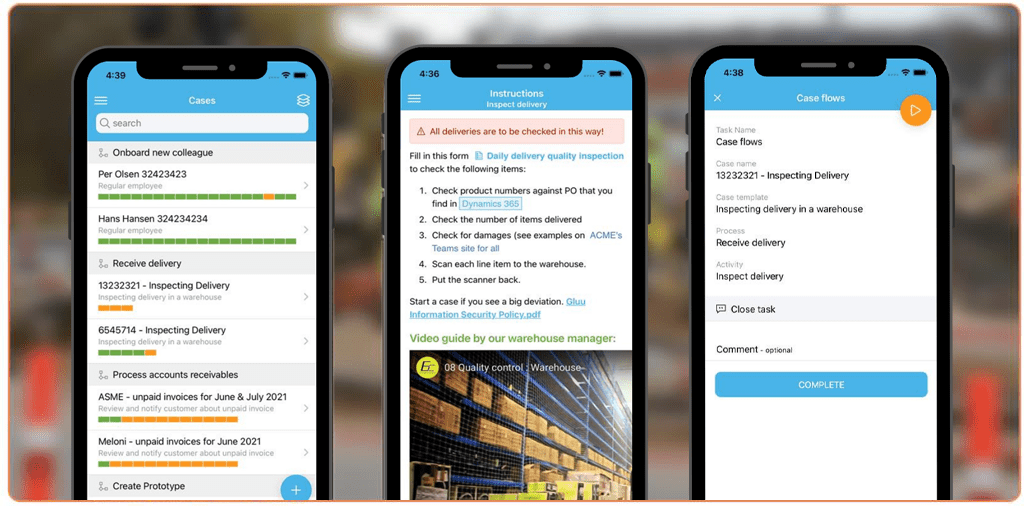
A key design decision was instruction format. Many workers on the factory floor are not strong readers and prefer visual guidance over text. Gluu made it possible to replace paper text with images and video directly in the app — the same work instruction platform, in a format that worked for everyone on the floor.
Paper forms were then recreated digitally — but smarter. The new forms are shorter, more focused on the specific task, and cannot be submitted incomplete. That last point alone eliminated the follow-up work that came with partial paper forms.
The final step was recurring task automation. A typical example: clean machine S-129 every day at 7am, with a deadline of the following day at 7am. Once configured in Gluu, the system generates the task automatically on schedule. Workers confirm completion with a single touch — optionally adding a photo. The data flows directly into the system, consistent and ready for analysis by process owners.
Having one platform to map processes, deliver visual instructions, automate recurring tasks, and capture registrations digitally makes the shift from paper to digital both practical and measurable. Gluu’s free trial is the most direct way to see how this applies to a production environment.
Gluu free 30-day trial. No credit card required. Start from €24 / year.
Results: 25,000 tasks, zero paper
Berry Superfos management reports three concrete outcomes from the factory process digitalization.
Task management time dropped by 90%. Automated task generation, digital form submission, and instant data capture eliminated the administrative overhead that came with paper-based management across all three shifts.
Employee involvement in process improvement grew from 10% to 90%. When processes are visible, instructions are accessible, and task completion is a single touch, more workers participate in identifying and acting on improvement opportunities. As Jakob Lund, former factory manager at Superfos Randers, put it: “With the Gluu platform, we are able to find new improvement opportunities, as it is easier to understand and optimise our cross-functional processes from initial order taking all the way through to production.”
Fewer errors and less waste from faulty products. Consistent task execution — following the same digital instructions every shift — and digital forms that cannot be submitted incomplete removed two common sources of variation.
The factory now has one common standard for all recurring work. Every process, instruction, role, and task is managed in a shared format. That single source of truth changed how workers find information: instead of asking a colleague or searching for a paper copy, they go to Gluu.
With the production line digitalized, Berry Superfos continued into the rest of the factory — order intake, production setup, and delivery. Their next step was to allow employees to start on-demand processes directly from Gluu: moving data from employees into the system, rather than only the system pushing tasks to employees. The goal, as they saw it, was a true end-to-end perspective on the factory’s work.
In brief
Berry Superfos’ Randers factory managed 25,000 tasks and registrations annually using paper forms and manual shift handovers. The existing quality management software only covered document maintenance — it could not handle task delegation or digital registration. The leadership team wanted to digitalize manual tasks to drive faster improvement cycles and reduce errors.
Gluu allowed managers to draw workflow diagrams and attach work instructions and recurring tasks to each step — all visible on Android tablets during task execution. That combination of process mapping, visual work instructions, and task management in a single platform was the deciding factor. The platform’s simple interface also worked for workers who don’t use IT in their daily routines.
Berry Superfos uses Gluu to manage recurring tasks across the production line. Workers receive automated task notifications on Android tablets, follow visual or video-based instructions, and confirm completion with a single touch. Paper forms have been recreated as shorter digital equivalents that cannot be submitted incomplete, and all registrations feed directly into the system for analysis by process owners.
Management reports 90% time savings on managing tasks and forms, and employee involvement in process improvement rising from 10% to 90%. The factory also reports fewer errors and less waste from faulty products. More than 25,000 tasks and registrations are now completed digitally each year, replacing all paper forms and manual shift handovers.
Yes. Berry Superfos deployed Gluu across a three-shift factory floor with 110 workers operating 67 automated machines. A key advantage was the platform’s usability for workers who don’t use IT in daily life — the simple interface worked on Android tablets without requiring prior digital experience. The gradual, process-by-process rollout also meant there was no downtime during implementation.