
CASE STUDY
Norlys builds energy sector BPM at scale — 700+ processes, 3,000+ users
When Norlys began integrating its acquisitions in 2020, the group’s processes existed in silos — managed by a small central team using a tool that most business users never touched. With 3,500 employees across multiple brands, the gap between documented processes and how work actually happened had become a liability.
The solution was not more documentation. It was a different approach to process governance altogether — one where the process structure followed Norlys’s value chain rather than its org chart, and where ownership sat close enough to the operation to drive real improvement.
Norlys chose Gluu as its BPM platform in 2020. Today the group has standardised and connected 700+ processes, managed by 100+ Process Owners with over 3,000 active users — and that same process foundation has become the backbone of the group’s ongoing ERP transformation.
The result is an organisation where process ownership is embedded at every level, quality is continuously raised, and improvement opportunities that previously went unnoticed are now visible and acted on.
“Gluu is easy to use. It’s really user-friendly — when we train people, it’s not the system that’s difficult. It is more to ensure quality in what is drawn in Gluu, so that it is consistent with the way we do it in the group.”
Julie Nørup Jensen
Process Consultant & Gluu Account Owner, Norlys
Scale
700
+
Processes standardised and connected across the organisation
All approved and commissioned processes in a single BPM platform
Ownership
100
+
Process Owners managing workflows across Norlys’s full value chain
Ownership assigned from director level down to team leads and specialists
Users
3,000
+
Active users across all brands and departments
Adoption driven by ease of use, not mandated rollout
Why Norlys chose a different approach to process governance
Two problems shaped Norlys’s decision to change its BPM platform in 2020. The existing tool generated little engagement among business users — processes were documented but rarely consulted. And the process structure itself mirrored the organisation chart, which produced blind spots wherever work crossed functional boundaries. Acquisitions made this worse: each new entity brought its own way of working, with no shared foundation to integrate into.
The decision was to rebuild the process foundation from scratch — this time structured around Norlys’s value chain rather than its reporting lines. Julie Nørup Jensen, Process Consultant and Gluu Account Owner at Norlys, explains: “We have created a process foundation that is as robust as possible. Therefore, we have chosen to separate it from the way we are organised, and it is different from what is done in many other places. We have chosen this to ensure that we do not have several processes for the same thing.”
This is where process governance as a discipline matters. A process hierarchy built on the value chain gives the helicopter perspective needed to see the full process landscape — including where processes overlap, where gaps exist, and where cross-functional improvements are possible. Many organisations make the mistake of copying their org chart into their process structure. The result is a system that reinforces silo thinking rather than breaking it down.
How Norlys uses Gluu across the organisation
Norlys uses Gluu as the single system of record for all approved and commissioned processes. The platform supports a three-tier ownership model that assigns accountability at every level of the organisation.
End-to-end processes are owned by directors from senior management, each covering a broad area such as HR — from employer branding to resignation. These are broken down into main processes, each with a main process owner at a high management level, covering a specific part of the end-to-end flow. Individual processes sit at the third tier, owned by a team leader or specialist in the field. This structure means process ownership is close enough to the operation to drive continuous quality improvement — not delegated so high that it becomes abstract.
With 100+ Process Owners managing 700+ processes, the scale of the implementation is significant. But according to Julie Nørup Jensen, user adoption has not been the limiting factor: “Gluu is easy to use. It’s really user-friendly, so when we keep modules to train people to use Gluu, it’s not so much the system that’s difficult. It is more to ensure quality in what is drawn in Gluu, so that it is consistent with the way we do it in the group. Here, Gluu is a great tool to collaborate, to standardise and to raise quality.”
With 3,000+ active users across the organisation, the challenge has shifted from system adoption to maintaining consistency in how processes are documented — a problem the platform actively supports through its collaboration and process management features.
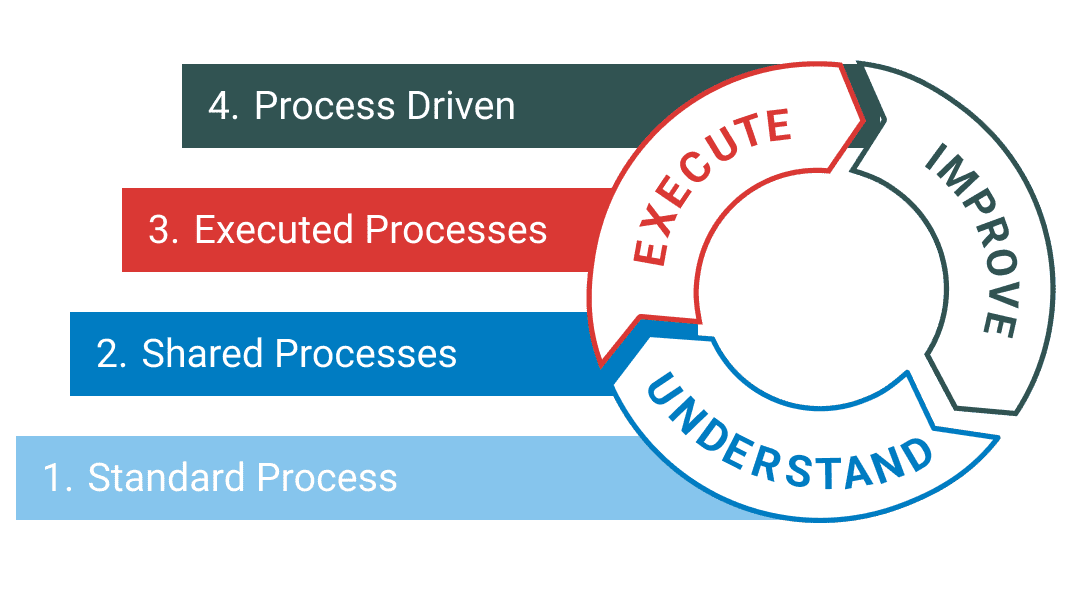
Having the right platform to document, execute, and track your processes makes every step of that improvement cycle faster and more reliable. If you want to see how that works in practice, Gluu’s free trial is a good place to start.
Gluu free 30-day trial. No credit card required. Start from €24 / year.
Results: from process foundation to business outcomes
The most concrete test of Norlys’s process foundation came with the group’s ongoing ERP transformation. Rather than starting the project from scratch, the team used the existing process landscape to scope it — identifying all areas affected by the new system, setting up the right process teams from the start, and involving all process owners in the transition to operations before go-live.
This is a direct outcome of having a solid process foundation in place. An ERP implementation that starts with mapped processes is scoped more accurately, involves the right people earlier, and transfers more cleanly to day-to-day operations. Process owners across all three tiers of the hierarchy participated in workshops covering ownership, process interfaces, and end-to-end handoffs — before the system went live.
Beyond the ERP project, the process work has surfaced improvement opportunities that were previously invisible — gaps at functional interfaces where ownership was unclear, and synergy effects across the group’s multiple brands. Julie Nørup Jensen is direct about the value this creates: “In addition to the obvious benefits of realised process gains, we also make visible the value creation of the process work for the entire group, so that the contribution of the process work to a stronger Norlys becomes very clear.”
Gluu now holds a multi-year contract with Norlys, and the collaboration is deepening. The immediate focus is on moving from As-Is process mapping to To-Be optimisation — starting with the processes that have the greatest potential for improvement. Norlys is also testing Gluu’s mobile app and exploring how task management can be connected to processes in security and control-related areas, with the goal of solving those tasks without adding new systems.
In brief
Norlys’s processes were managed in silos by a small central team, and the BPM tool in use at the time did not engage business users. With the group integrating acquisitions and looking to realise synergies across multiple brands, the gap between documented processes and real-world workflows had become a strategic liability.
Norlys needed a platform that business users would actually engage with — one where processes were used rather than just documented. Gluu’s ease of use was a decisive factor. According to Julie Nørup Jensen, training sessions on the platform focus on ensuring quality of documentation rather than on navigating the system itself.
Norlys uses Gluu as the single source of truth for 700+ processes across the organisation. A three-tier ownership model assigns end-to-end processes to directors, main processes to senior managers, and individual processes to team leaders or specialists — keeping ownership close to operations and supporting continuous quality improvement.
Norlys has standardised and connected 700+ processes, managed by 100+ Process Owners with more than 3,000 users across the group. The process foundation was used to scope and run the group’s major ERP transformation — identifying all affected areas, setting up the right teams early, and preparing process owners for go-live before the system launched.
Norlys’s experience suggests it is. For organisations managing multiple brands or subsidiaries after acquisitions, a value-chain-based process hierarchy in Gluu provides the common foundation needed to standardise operations without imposing a single organisational structure. The platform scales to 3,000+ users while remaining accessible enough for non-specialist process owners.