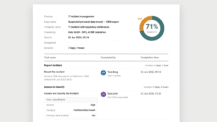
Case management in BPM

Not all work follows a predefined process. In fact, many business activities require people to adapt, make decisions based on context, and respond to changing circumstances. Therefore, when teams cannot fully standardize work, organizations often turn to case management.
Case management is a way of organizing work around a specific case rather than a fixed sequence of tasks. Moreover, it helps teams manage information, decisions, documents, and activities while maintaining visibility and progress. Within Business Process Management (BPM), case management specifically supports work that depends on collaboration, flexibility, and continuous evaluation.
In this guide, we explain what case management is, how it differs from traditional workflows, when organizations use it, and how software supports successful execution.
Key takeaways:
- Case management addresses work that teams cannot fully standardize.
- Cases evolve as information changes and teams make decisions.
- BPM and case management work together rather than compete.
- Case management software improves visibility, coordination, and execution.
- Organizations get the best results when they combine repeatable workflows with flexible case handling.
What is case management?
Case management is an approach where teams organize activities around achieving a goal rather than completing a predefined process. Instead of moving through a fixed workflow, teams adapt their actions as new information becomes available.
A case typically includes:
- Tasks and activities
- Documents and data
- Decisions and approvals
- Communication between stakeholders
- Progress toward resolution
Importantly, the objective is not simply to complete steps but to reach the desired outcome. As a result, case management becomes especially valuable for knowledge work and situations where no two cases look exactly alike.
Examples include:
- Resolving customer issues
- Managing internal projects
- Handling compliance investigations
- Coordinating onboarding processes
- Managing operational exceptions
Essentially, the goal is to keep work moving while maintaining structure—even when exceptions occur.
Case management vs. traditional workflow
Traditional workflows handle predictable, repeatable work, while case management supports dynamic and evolving work. Here’s a quick overview of how they compare:
| Traditional workflow | Case management |
|---|---|
| Fixed process | Adaptive process |
| Tasks follow predefined order | Activities change based on context |
| High automation potential | Human decisions play a larger role |
| Predictable outcomes | Variable outcomes |
| Efficiency focused | Outcome focused |
However, this doesn’t mean one approach is better than the other. In practice, most organizations use both. For example, invoice approval usually follows a standard workflow, while handling customer escalations often requires case management. Ultimately, the key is identifying where structure creates value and where flexibility becomes necessary.
When should businesses use case management?
Organizations benefit from case management when processes involve uncertainty, collaboration, or frequent exceptions.
Customer service and issue resolution
Customer requests rarely follow identical paths. Therefore, a case-based approach allows teams to gather information, involve relevant stakeholders, and adapt actions until they resolve the issue.
Compliance and governance
Compliance activities often require documentation, approvals, investigations, and changing actions based on findings. As a result, case management helps maintain transparency while supporting flexibility.
Project and initiative management
Projects involve dependencies, changing requirements, and evolving priorities. Consequently, managing work as cases creates visibility without forcing teams into rigid workflows.
Operational exceptions
Even highly optimized processes encounter situations that demand human intervention. In these moments, case management keeps those exceptions controlled and documented.
Key elements of case management
Good case management runs as a cycle. The names vary by industry, but the fundamentals stay the same. Most case work includes:
- Assessment
Collect information, understand needs, identify risks, and define the desired outcome. - Planning
Create a plan: tasks, roles, milestones, decision points, and required documentation. - Implementation
Execute the plan with clear ownership, templates, and agreed working practices. - Coordination
Manage handoffs across people, teams, and systems—so nothing gets stuck. - Monitoring
Track progress, deadlines/SLAs, changes, and exceptions in real time. - Evaluation and closure
Confirm outcome, document learnings, and close the case with audit-ready evidence.
Together, these stages form the operating rhythm that a modern case management system supports—keeping people aligned and cases controlled.
Benefits of case management software
Managing cases manually becomes difficult as complexity increases. In contrast, case management software creates a shared operational environment where teams coordinate work more effectively. Common benefits include:
- Centralized information: All relevant activities, decisions, and documents stay connected to the case.
- Better collaboration: Teams contribute across departments while maintaining context.
- Greater flexibility: Teams adapt work without redesigning entire workflows.
- Increased visibility: Managers gain insight into progress, bottlenecks, and outcomes.
- Improved execution: Teams spend less time coordinating manually and more time moving cases forward.
To achieve these benefits, look for solutions that offer the following capabilities:
- Intake & triage: Forms, email capture, classification, priority rules, and routing.
- Role-based assignment: Owners, collaborators, escalation paths, and handover standards.
- Task orchestration: Checklists, milestones, deadlines, and reminders.
- Documentation & evidence: Notes, attachments, approvals, version control, and audit trails.
- Status visibility: Dashboards, queues, “what’s next,” and case history for context.
- Automation where it makes sense: Notifications, templated actions, and integration with systems of record.
- Reporting & improvement: Cycle time, bottlenecks, workload balance, compliance metrics, and outcomes.
Example features of a case management system
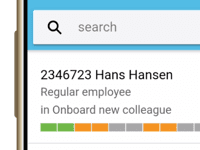
Track case progress
Monitor how cases and projects are progressing in a single view.
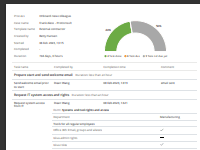
Automatic case reporting
Generate automatic case reports to document work and support traceability and compliance needs.
Want to be inspired? Then take a look at how a 200-employee contractor in the construction industry benefitted from an integrated approach to case management and business process management:
Case management in Business Process Management (BPM)
In BPM-driven organizations, not all work can follow a predefined workflow from start to finish. Even well-designed processes eventually encounter exceptions, missing information, or situations that require human judgment. This is where case management in BPM becomes part of the execution model.
Instead of breaking the process, a case keeps execution moving within the BPM system even when the predefined path no longer applies. The process instance remains intact, but work becomes dynamic: teams can add, skip, reorder, or assign tasks based on context. In practice, case management in BPM is not separate from process management—it operates as an extension of the process runtime.
A typical flow looks something like this:
Modeled BPM process → exception occurs → case initiated → dynamic tasks and decisions → resolution completed → process resumes
This combination allows organizations to standardize operations without losing adaptability. As a result, by integrating case management into BPM initiatives, businesses create processes that remain efficient while still supporting real-world complexity and flexibility.
How case management supports continuous improvement
One of the key advantages of combining case management with BPM is that it produces detailed execution data from real work—not just designed workflows. While traditional BPM focuses on how a process should run, case-driven execution shows how work actually happens when exceptions, delays, and deviations occur.
By analyzing case execution patterns, organizations can identify:
- Where processes most frequently break or diverge
- Which steps generate delays or repeated manual intervention
- Where teams consistently need decisions outside the modeled flow
- Which types of cases trigger escalations or rework
- Where automation or standardization would remove friction
Consequently, this creates a direct feedback loop into BPM design:
Case execution → operational data → pattern detection → process model refinement → improved execution
Over time, this leads to BPM systems that operate not as static models but as continuously improving operational frameworks shaped by real-world behavior.
How Gluu supports case management
In BPM environments, the challenge is not choosing between structured processes and flexible case handling—it is enabling both within the same operational system. Gluu specifically delivers this combined model through modern business process management software.
Processes define the structured backbone of work, while cases handle the real-world variation that occurs during execution. When teams instantiate a process, they can execute it as a standard workflow or adapt it into a case when context requires deviation.
Within Gluu, this means:
- Process models act as templates for case execution
- Teams can add, modify, or skip tasks based on context
- Teams retain visibility into both the original process and live adaptations
- Gluu preserves execution history for auditability and improvement
- Process and case data live in the same operational environment
In short, Gluu combines BPM and case management into a single model of work: structured where possible, flexible where necessary, and always traceable end-to-end. As a result, organizations maintain process discipline without losing adaptability in execution.
Run a case with Gluu for free
Gluu free 30-day trial. No credit card required. Start from €24 / year.
FAQ – Case management in BPM
Case management in BPM is the part of the execution model that handles work which cannot follow a predefined workflow from start to finish. Instead of breaking the process when exceptions occur, a case keeps execution moving inside the BPM system, allowing teams to add, skip, reorder, or assign tasks based on real-world context.
A traditional workflow follows a fixed sequence of tasks designed for predictable, repeatable work. Case management, on the other hand, supports dynamic and evolving work where activities change based on context and human decisions play a larger role. Most organizations use both: workflows for the happy path, cases for exceptions.
Most case work runs as a cycle of six elements: assessment, planning, implementation, coordination, monitoring, and evaluation and closure. Together these stages give teams a consistent way to handle complex work without forcing it into a rigid sequence.
Organizations benefit from case management when processes involve uncertainty, cross-functional collaboration, or frequent exceptions. Typical use cases include customer service and issue resolution, compliance and governance, project and initiative management, and operational exceptions inside otherwise standardized BPM processes.
Case management produces detailed execution data from how work actually happens, not just how it was designed. By analyzing case patterns—where processes break, where decisions sit outside the modeled flow, which cases trigger rework—organizations create a feedback loop that continuously refines their BPM models.
Strong case management software typically supports intake and triage, role-based assignment, task orchestration with deadlines, documentation and evidence with audit trails, status visibility through dashboards, sensible automation, and reporting on cycle time, bottlenecks, and outcomes.
The main principle is coordinated ownership with the right context: one accountable owner keeps the case moving while everyone involved shares visibility into decisions, actions, and evidence. In short, structure where it’s needed, flexibility where it’s required.