Process compliance: meaning, benefits & best practices

Process compliance has changed. For years, organisations treated it as a binder of static manuals and top-down checklists that nobody read until an audit loomed. Today, the smartest teams build compliance directly into how people work every day — visual, collaborative, and continuous. This guide explains what the term means, why it matters, and how to build a culture where doing the right thing is simply how work gets done.
What is the meaning of process compliance? Process compliance is the practice of ensuring that day-to-day workflows are carried out in line with internal policies, external regulations, and quality standards. In other words, it confirms that work is not only defined correctly but also executed correctly, every time, by every person involved.
What is process compliance?
Definition of process compliance
At its core, compliance is the process of aligning everyday work with the rules that govern it. Those rules come from three places: internal policies, external regulations, and recognised quality standards. Process compliance asks a simple question — are people actually following the agreed way of working?
It helps to separate two ideas that often get blurred. General corporate compliance covers what an organisation must adhere to, such as data protection law or financial reporting obligations. The compliance process, by contrast, is about how that work is executed on the ground. Therefore, a company can have excellent policies on paper and still fail, because adherence breaks down where the work actually happens.
This distinction matters because regulators, auditors, and customers increasingly want evidence, not promises. As a result, a strong compliance management process must connect the rulebook to the daily task. Without that link, documentation becomes shelfware and risk creeps back in.
Why it matters for your business
The business case is straightforward. Consistent, controlled workflows reduce operational risk, improve accountability, and protect the organisation from costly legal penalties. Furthermore, they create the predictability that customers and partners depend on.
Consider the alternative. When every team interprets a procedure differently, quality becomes a lottery and mistakes multiply. However, when work follows a clear standard, problems surface early and improvement becomes possible. In practice, a robust compliance risk management process is what lets a company scale without multiplying its exposure.
Above all, business process compliance is a foundation for growth. Investors, certifying bodies, and enterprise clients all look for proof that operations are controlled. Consequently, the organisations that treat it as an enabler — not a brake — tend to win bigger contracts and enter regulated markets faster.
The three categories you need to know
Most compliance obligations fall into three broad categories. Notably, understanding which type applies helps teams design the right controls rather than treating everything the same way.
The three types of compliance are regulatory, internal, and industry or quality standards. Regulatory compliance covers external laws such as GDPR, HIPAA, and SOX. Internal compliance covers an organisation’s own rules, including SOPs and safety guidelines. Industry compliance covers voluntary but expected standards such as ISO 9001 and ISO 14001.
| Type | What it governs | Examples |
|---|---|---|
| Regulatory | External laws and government mandates | GDPR, HIPAA, SOX |
| Internal | An organisation’s own policies and rules | SOPs, safety guidelines, codes of conduct |
| Industry / quality | Voluntary but expected standards | ISO 9001, ISO 14001 |
The core stages of a compliance process
The 4 stages, step by step
Most effective programmes move through four repeating stages. Specifically, they form a loop rather than a one-time project, because rules and risks keep changing.
- Identify requirements and risks. Map which regulations, policies, and standards apply, then assess where the organisation is most exposed.
- Develop policies and procedures. Translate those requirements into clear, documented ways of working that people can actually follow.
- Implement training and controls. Embed the procedures into daily work and equip employees to follow them correctly.
- Monitor, audit, and improve. Track performance, catch gaps, and feed lessons back into the process.
As such, the four stages of compliance describe a cycle of continuous control. Fortunately, modern tools make each stage lighter, so the loop runs without grinding work to a halt.
Compliance is not a binder you open before an audit. It is the quiet result of people doing the right thing because the right thing is the easiest thing to do.
The 5 pillars that hold it up
If the four stages describe the motion, the five pillars describe the structure that holds it up. Together, they answer the question of what a healthy programme needs to stand on.
The five pillars of compliance are documented policies, leadership accountability, employee training, monitoring and reporting, and continuous improvement. Remove any one of them and the others wobble. For example, strong policies without leadership backing rarely change behaviour, and training without monitoring leaves you blind to whether it worked.
| Pillar | Why it matters |
|---|---|
| 1. Documented policies | Gives everyone a single, clear source of truth for how work should be done. |
| 2. Leadership accountability | Sets the tone; behaviour rarely changes unless leaders follow the rules too. |
| 3. Employee training | Equips people to follow procedures correctly, at the moment they need to. |
| 4. Monitoring and reporting | Reveals whether the rules are actually being followed in practice. |
| 5. Continuous improvement | Keeps the programme alive as risks, rules, and the business evolve. |
Key components of business process compliance
Policy adherence and documentation
Documented procedures are the backbone of business process compliance. Standard operating procedures capture the agreed way of working so that quality does not depend on who happens to be on shift. Without them, knowledge lives in people’s heads and walks out the door when they leave.
However, static documentation routinely fails. Employees cannot find a buried PDF, struggle to read dense text, and quietly revert to old habits. Therefore, the answer is not more paperwork but better access. Visual process mapping turns a wall of text into a clear flow that people can follow at a glance.
This is where the contract compliance process and many other workflows benefit most. When a procedure is mapped visually and linked to the task at hand, adherence stops being a memory test and becomes the path of least resistance.

“It makes it easier to follow the procedure.”
Ole Brøker, Machine Operator, Superfos
Training and employee awareness
Compliance training is too important to leave to a once-a-year classroom session. People forget most of what they hear within days, and annual training rarely matches the moment a decision is actually made. Instead, awareness should be continuous and contextual.
The modern approach embeds “just-in-time” guidance directly inside the tasks employees perform. For instance, a work instruction can appear at the exact step where it is needed, so the right way is always within reach. Consequently, employees learn by doing, and compliant behaviour becomes a habit rather than an event.
Monitoring, reporting, and auditing
You cannot manage what you cannot see. Monitoring gives leaders a live view of whether work is being done to standard, while reporting turns that visibility into evidence. Together, they replace gut feeling with fact.
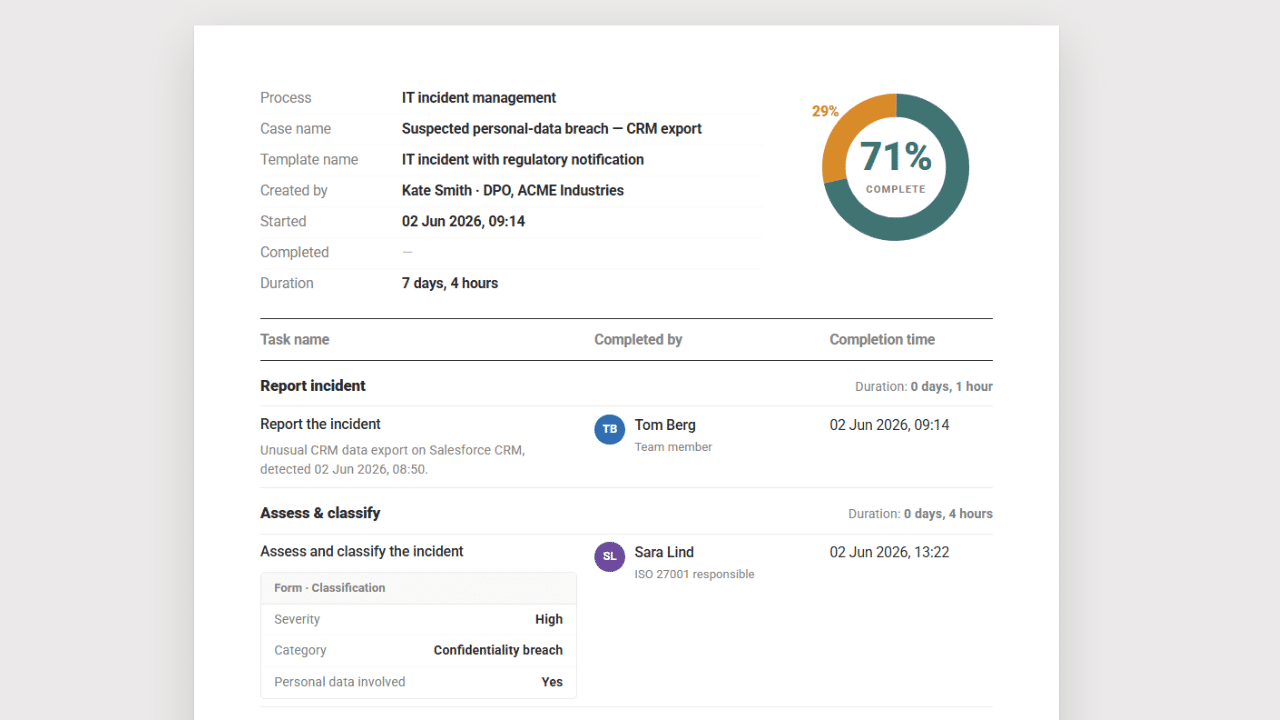
Automated audit trails are a quiet superpower here. Rather than reconstructing what happened after the fact, a well-designed system records each step as it occurs. As a result, the contract compliance audit process becomes far less painful, and the broader compliance reporting process produces trustworthy data on demand.
Why incident reporting matters
Incidents are inevitable; hiding them is the real danger. A healthy incident reporting process gives people a safe, simple way to flag what went wrong so the organisation can respond. Why are incident reports important in the compliance reporting process? Because they convert isolated mistakes into shared lessons and trigger corrective action before small problems become big ones. Moreover, a transparent record of incidents and responses is exactly the kind of evidence auditors and regulators expect to see.
How to ensure process compliance in an organisation
Build a clear compliance framework
Strong results start with structure. A clear framework defines governance, assigns responsibilities, and sets out what happens when something goes wrong. Specifically, it should name who owns each process and who must act when an exception arises.
A responsibility model such as RACI removes the ambiguity that lets things slip. By clarifying who is responsible, accountable, consulted, and informed, the compliance management process gains teeth. Furthermore, defined escalation paths mean issues reach the right person quickly, which is the heart of any compliance risk management process.
Use automation and compliance technology
Manual compliance built on spreadsheets and email chains is fragile by design. Versions drift, approvals get lost, and no one can prove what happened. By contrast, modern BPM software monitors workflows, reduces human error, and generates audit trails automatically.
The shift is profound. Instead of chasing people for sign-offs, the system routes work, records each action, and flags anything that stalls. Consequently, business process compliance stops being a separate chore and becomes a byproduct of simply doing the work the right way.
The short video below shows this idea in action — how compliance becomes a natural result of working inside a well-designed process, rather than a task bolted on top of it.
Conduct regular audits and reviews
Audits should not feel like a fire drill. When the only review is a stressful annual inspection, teams scramble, evidence is patchy, and the findings arrive too late to help. Instead, treat auditing as a continuous, lightweight habit.
With live data and automated trails, internal reviews can run little and often. Therefore, gaps surface while they are still small, and the contract compliance audit process becomes a routine check rather than an ordeal. That said, periodic deep reviews still have their place — they simply stop being the only safety net.
Encourage a culture of accountability
Technology and frameworks only go so far without the right culture. How do you ensure process compliance in the long run? You make it everyone’s job, not just the compliance officer’s. Leadership sets the tone by following the same processes it asks of others, and employees engage when they see that their input shapes how work is done. In short, accountability sticks when people feel ownership rather than surveillance.
Examples of process compliance across departments
Hiring and recruitment compliance
Recruitment is full of compliance landmines: equal opportunity rules, background checks, and data privacy obligations all apply at once. Hiring process compliance ensures every candidate is treated fairly and that the required documentation is collected consistently.
So what do the best companies for recruitment process compliance do differently? They standardise the workflow. By using visual, repeatable hiring steps, they guarantee that each applicant goes through the same checks, that approvals are logged, and that sensitive data is handled correctly. This is, in essence, how to create a compliance-driven hiring process — make the compliant path the default path.
Contract compliance processes
Contracts only deliver value if their terms are actually honoured. The contract compliance process ensures that obligations in vendor agreements and service level agreements are tracked and met, not forgotten once the ink dries. For example, renewal dates, deliverables, and performance thresholds can all be tied to scheduled tasks. As a result, the audit trail has a clean record to follow whenever proof is required.
Finance and procurement compliance
Finance is where weak controls hurt fastest. Purchase order approval workflows and accounts payable checks exist to stop unauthorised spending and fraud. How do you enforce PO compliance in the AP process? By routing every purchase through a defined approval flow, so no invoice gets paid without a matching, approved order. Consequently, segregation of duties is preserved and the audit trail is automatic.
Operational and quality compliance
On the operational front, control lives in standardised work: SOPs, quality assurance, Lean, and Six Sigma process compliance all aim to remove variation. When everyone follows the same defined method, defects fall and quality becomes predictable.
Two real examples show the payoff. Danish construction firm Holbøll achieved ISO 9001 certification with zero nonconformities by mapping its processes visually and linking daily tasks directly to the relevant ISO requirements. Meanwhile, LKF Vejmarkering used structured process documentation to transfer critical operational knowledge from retiring veterans to new hires, so quality standards held steady through a generational handover.
Common challenges in process compliance
Even committed organisations hit predictable obstacles. Recognising them early makes them far easier to manage.
- Inconsistent processes across teams. Undocumented or fragmented workflows mean each group works its own way, which makes adherence impossible to prove.
- Lack of employee engagement. Dry manuals, dull training, and clunky tools get ignored, so good intentions never reach the front line.
- Changing regulations and requirements. Rules evolve constantly, which demands process maps that are easy to update rather than rewrite.
- Manual processes and human error. Reliance on spreadsheets and email chains invites mistakes and leaves no reliable record.
Best practices for long-term success
The organisations that sustain strong results share a handful of habits. Most importantly, they treat it as part of running the business well, not as a separate burden.
- Standardise and simplify. Keep workflows visual and easy to understand so people can follow them without effort.
- Align with business goals. Design controls that support efficiency rather than slow it down.
- Measure performance. Track audit pass rates, incident frequency, and training completion to see what is working.
- Continuously improve. Build feedback loops where employees can suggest better ways of working, then act on them.
Taken together, these practices turn compliance from a defensive cost into a genuine operational advantage. If you are ready to see what that looks like in practice, the next step is simple.
Gluu free 30-day trial. No credit card required. Start from €24 / year.
Conclusion & call to action
Proactive, people-first process compliance is no longer a nice-to-have. By moving away from static manuals toward visual, integrated, and collaborative workflows, organisations reduce risk, lift quality, and free their teams to focus on the work that matters. The goal is a culture where the right way of working is built in, not bolted on.
See how Gluu makes it effortless. Book a demo to explore visual process mapping and compliance automation that turn good intentions into everyday practice.
FAQ – Process compliance
General compliance covers what an organisation must obey — the laws, regulations, and standards that apply to it. Process compliance covers how that work is carried out day to day, making sure people actually follow the approved way of working. You need both: good rules on paper mean little if the process that delivers them breaks down.
Route every purchase through a defined approval workflow so that no invoice is paid without a matching, approved purchase order. Automating this flow preserves segregation of duties, blocks unauthorised spending, and creates an automatic audit trail. As a result, accounts payable controls hold up under scrutiny without manual chasing.
Incident reports turn isolated mistakes into shared lessons and trigger corrective action before small issues escalate. They also create a transparent record of what went wrong and how the organisation responded — exactly the evidence auditors and regulators expect. In short, they make the compliance reporting process honest and actionable.
The three types are regulatory compliance (external laws such as GDPR, HIPAA, and SOX), internal compliance (an organisation’s own SOPs and safety rules), and industry or quality compliance (recognised standards such as ISO 9001). Most organisations must manage all three at once, which is why a clear, structured process matters.