Business process intelligence: meaning, benefits and best practices

Most organisations sit on mountains of operational data, yet their teams still work from gut feeling. Business process intelligence (BPI) closes that gap. This guide explains what BPI means, how it differs from traditional business intelligence, and why a people-first approach is what finally turns process data into daily action.
For years, business process intelligence meant cold system monitoring: log-based tracking, complex diagrams, and dashboards that only a handful of analysts could read. That technical approach captured the data but missed the people. The modern approach is different. It is visual, collaborative, and built around the employees who actually run the work. Therefore, this article treats BPI as a practical bridge between data insight and human execution, not as another IT reporting layer.
What is business process intelligence? Business process intelligence is the practice of collecting, analysing, and monitoring operational data to understand how workflows run and where they can improve. It turns raw system data into clear, actionable insight, helping managers and frontline employees make better decisions and continuously refine the way work gets done.
What is business process intelligence?
Business process intelligence is the discipline of gathering operational data, analysing it, and feeding the results back into everyday work. In practice, it answers three questions: how does a process actually run, where does it break down, and what should we change? Because it focuses on real execution rather than theory, BPI gives organisations an honest picture of their workflows.
However, data alone changes nothing. The real value appears when process business intelligence connects to human-centric business process management. BPM is the discipline of designing, running, and improving how work happens. BPI makes that discipline smarter by showing teams exactly where to act. As such, the two work best together: BPM gives structure, and BPI supplies the evidence.
Why business process intelligence matters
Operational friction is expensive. Every handover delay, every rework loop, and every undocumented exception drains time and money. Consequently, organisations that can see their processes clearly move faster and stay more consistent than those that cannot.
That said, the deeper reason BPI matters is human. Purely technical data is useless if it never changes behaviour. A dashboard buried in head office does not help the person processing an invoice or onboarding a new hire. BPI matters because it translates complex system data into clear steps for the people doing the work. In other words, it makes insight usable at the frontline, not just at the executive level.
Process mining vs business intelligence vs BPI: the human gap
These three terms overlap, which causes confusion. The table below sets them apart before we look at each in detail.
| Approach | Data source | Primary user | Main limitation |
|---|---|---|---|
| Process mining | Event logs from IT systems (ERP, CRM) | Process analysts | Often limited to analysis within a single large system such as an ERP. This says more about how the system is used than the process it is part of. |
| Business intelligence (BI) | Aggregated business data (sales, finance) | Executives, managers | Disconnected from daily, manual execution |
| Business process intelligence (BPI) | Both, plus human context | Managers and frontline employees | Requires usable, collaborative tools to deliver value |
What is process mining? (system-centric)
Process mining reconstructs workflows from event logs inside IT systems. For example, it can pull timestamps from an ERP or CRM and reveal the real path an order took, including every detour. This is powerful for spotting bottlenecks and deviations.
Nevertheless, that is the theory.
In practice process mining often resembles the old joke where a man looks for his wallet under a street light. A passerby then asks him if he lost it there to which he replies that he lost it in the dark but there is more light under the street light.
Process mining lets you mine data that often only represent a small part of the real process. So it can become more about systems usage optimisation, than real process optimisation.
What is traditional business intelligence (BI)?
Traditional business intelligence aggregates and visualises high-level data to support strategy. Finance, sales, and operations leaders use BI dashboards to track performance and decide where to invest. For high-level direction, it works well.
However, BI sits a long way from the shop floor. It tells leadership that order processing is slow, but it does not show the clerk which step to fix. By contrast with execution-level detail, BI describes outcomes rather than the daily, manual work that produces them. That disconnect is exactly where many improvement initiatives stall.
How BPI bridges the gap
BPI is the holistic layer that joins these worlds. It takes the deep workflow insight of process mining and the clear visualisation of BI, then translates both into steps that frontline teams can follow. Specifically, it pairs the “what is happening” with the “what to do next.”
This is the human gap, closed. Instead of a diagram only experts understand, BPI delivers a visual process that anyone can read, comment on, and execute. Because the insight reaches the people doing the work, behaviour actually changes, and improvement becomes continuous rather than occasional.
The core pillars and elements of business intelligence and BPI
Understanding the building blocks helps clarify where BPI adds value. Below are the four foundational pillars and the six technical elements that make an intelligence system work.
The four pillars of business intelligence and BPI
The four pillars describe how raw data becomes a decision. Notably, BPI is what connects the final pillar to real human processes.
- Data integration (ETL): Gather data from the various operational systems an organisation runs.
- Data warehousing: Store that data in a centralised, accessible repository.
- Data analytics and reporting: Analyse the data to surface trends, patterns, and bottlenecks.
- Data-driven action (the BPM connection): Present insights to teams so they can change their behaviour and improve workflows.
Most BI projects stop at the third pillar. The fourth pillar is where BPI and business process management take over, because insight only creates value once people act on it.
The six elements of business intelligence and BPI
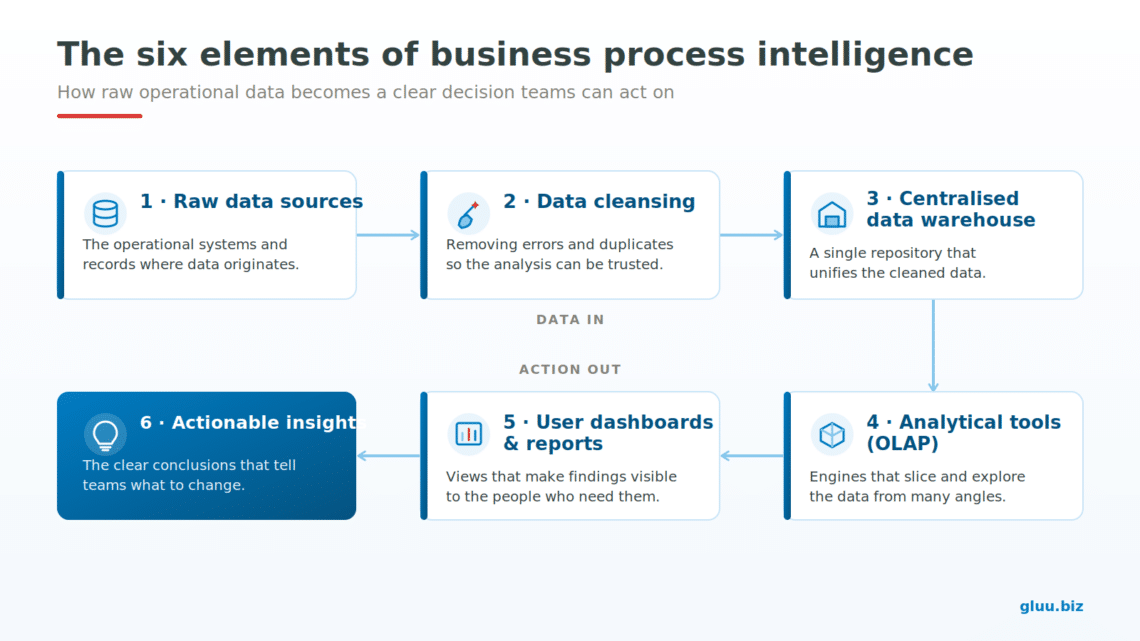
A working intelligence system rests on six practical elements. Together they move data from messy source to confident action.
- Raw data sources: The operational systems and records where data originates.
- Data cleansing: Removing errors and duplicates so the analysis can be trusted.
- Centralised data warehouse: A single repository that unifies the cleaned data.
- Analytical tools (OLAP): Engines that slice and explore the data from many angles.
- User dashboards and reports: Views that make findings visible to the people who need them.
- Actionable insights: The clear conclusions that tell teams what to change.
Key benefits of implementing business process intelligence
The payoff from BPI shows up across decisions, automation, and cost. Here are the three that matter most.
Data-driven decision-making
BPI moves teams from gut feeling to evidence. Instead of guessing why a process slows down, managers see the concrete data. Furthermore, because process intelligence reaches every level, frontline staff gain the same clarity that leaders enjoy. That shared visibility leads to faster, better decisions throughout the organisation.
Targeted automation and ROI
Automation budgets are easy to waste. BPI helps by pinpointing exactly where process automation or AI will deliver the highest return. Above all, it stops a common mistake: automating a broken, chaotic process. Doing that only digitises the chaos and locks in the very problems you meant to fix. By contrast, mapping the process first ensures automation amplifies a sound workflow.
Lower operational costs and continuous improvement
Complete visibility into workflows lets teams remove bottlenecks and cut waste. More importantly, it creates a living culture of continuous improvement. When employees can see their own processes and suggest changes, improvement stops being a top-down project and becomes everyday practice. Consequently, costs fall while quality and consistency rise.
Real-world use cases: where BPI meets human-centric BPM
BPI proves its worth in daily operations, not slideshows. In practice, this is where a platform like Gluu turns insight into execution.
Consider process compliance. Many organisations struggle to prove that work follows the approved procedure. With visual processes and linked standard operating procedures, teams can see the correct steps and follow them consistently, which makes compliance a by-product of normal work rather than an audit scramble.
Collaborative feedback is another strong example. Because frontline employees often spot problems first, Gluu lets them suggest improvements directly inside the visual process map. That feedback loop feeds real execution data straight back to process owners, turning the people who run the work into the engine of continuous improvement.

“The improvement ideas that constantly flow from our employees are all reported digitally, picked up by process owners, and some incorporated back into our management system.”
Read case
Hans Jørgen Ebbesen,
CEO, CJ A/S
Choosing the right business process intelligence software
Here is the hard truth about BPI initiatives: they fail when the software is too technical. If only a small group of process-excellence experts at headquarters can read the tool, the insight never reaches the frontline, and nothing changes.
The right software therefore combines data insight with usability. Specifically, it should pair analysis with user-friendly process mapping, built-in collaboration, and clear work instructions. When a tool is easy to use, employees adopt it, execute against it, and keep improving it. That adoption is what separates a BPI investment that pays off from one that gathers dust.
This is where Gluu fits. Many organisations run a process-mining or BPI initiative to find what needs fixing, then need a human-centric execution platform to actually act on it. Gluu is built for that role: it makes processes visual, collaborative, and continuously improved, so the insight from your BPI tools turns into real change on the ground. See how it works for yourself.
Gluu free 30-day trial. No credit card required. Start from €24 / year.
Common challenges in business process intelligence
Even strong initiatives hit predictable obstacles. Recognising them early makes them easier to manage.
- Inconsistent processes across teams: Undocumented or fragmented workflows that systems simply cannot track reliably.
- Lack of employee engagement: Complex tools, dry manuals, and technical dashboards that employees quietly ignore.
- Changing regulations and requirements: The constant need for agile, easily updatable process maps that keep pace with new rules.
- Manual processes and human error: The risk that comes from relying on spreadsheets and email chains instead of structured, visible workflows.
Best practices for long-term BPI success
Sustained success comes from a few disciplined habits rather than a single big project.
First, standardise and simplify your processes. Keep workflows visual, collaborative, and easy enough that any employee can understand them without training.
Second, align BPI with business goals. Data insight should support human efficiency, not bury teams under complex reporting. In short, every metric should help someone do their job better.
Third, measure performance and foster feedback loops. Establish collaborative channels where employees suggest improvements based on what they see in real execution. This keeps your process performance measurement grounded in reality and keeps improvement continuous.
Conclusion
Business process intelligence has outgrown its technical past. Today, the organisations that win are the ones that make BPI proactive and people-first, turning raw data into steps their teams can actually follow. The data matters, but the human execution is what delivers the result. If you are ready to make your own processes visual, collaborative, and continuously improved, Gluu is built to take you there.
FAQ – business process intelligence
Process mining reconstructs how a specific workflow actually runs by reading event logs from IT systems, so it focuses on operational detail. Business intelligence aggregates high-level data such as sales and finance to support strategic decisions. In short, process mining shows how work happens, while BI shows what the business outcomes are. BPI combines both and adds the human context needed to act.
The four pillars are data integration (ETL), data warehousing, data analytics and reporting, and data-driven action. The first three turn raw data into insight. The fourth, data-driven action, is where business process management connects insight to the people who can change how work is done.
The six elements are raw data sources, data cleansing, a centralised data warehouse, analytical tools (OLAP), user dashboards and reports, and actionable insights. Together they move information from a messy source to a clear conclusion that teams can act on.
Usability decides whether a BPI initiative succeeds or fails. If only a few experts can read the tool, the insight never reaches the frontline and behaviour never changes. When the software is simple and visual, employees adopt it, execute against it, and keep improving it, which is what finally delivers value.