Where does an organisation’s intent actually live – and can an AI read it?

An organisation’s intent starts with its strategy, but it only becomes usable in a business process model that connects the strategy to the people, roles, systems and rules that deliver its products and services. A process map on its own does not hold intent, and neither does a folder of SOPs.
In short, intent lives in the connections between the levels, from value stream down to the individual task. That is also what an AI agent needs before it can act on your behalf.
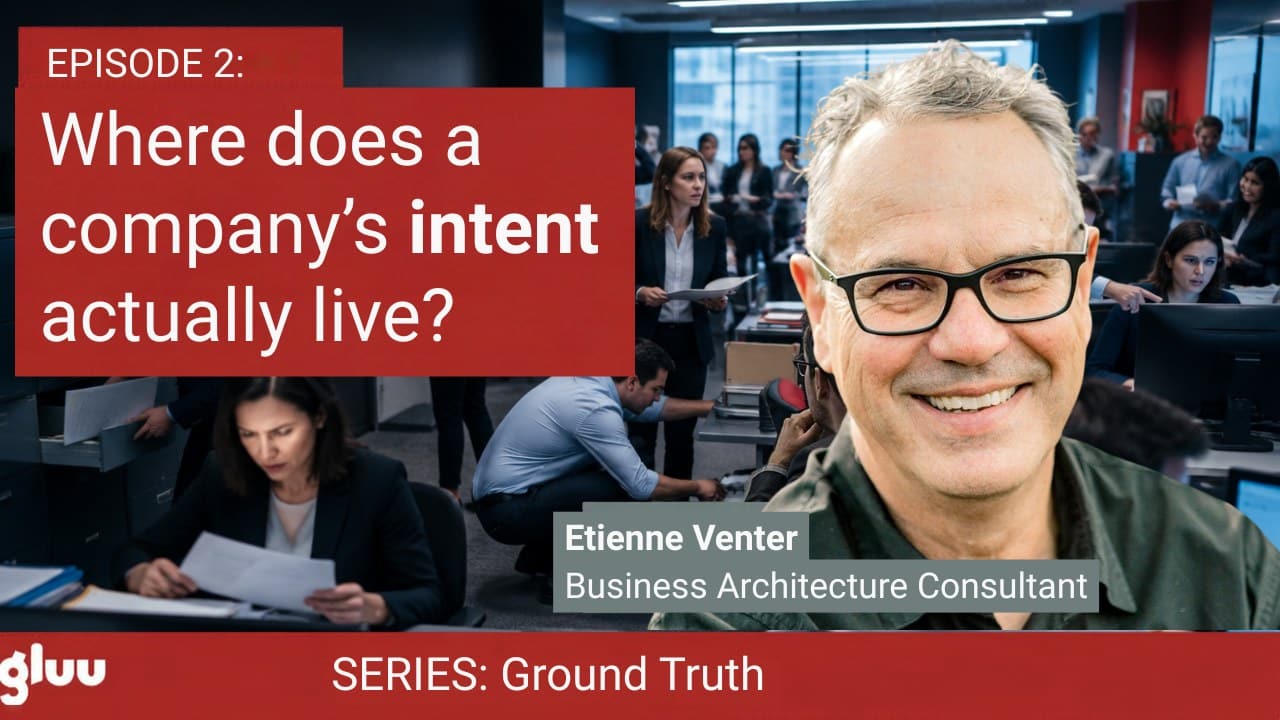
This article is based on a Ground Truth conversation with Etienne Venter, Process Consultant at Process2Product. Before starting his own firm, he spent many years as an enterprise architect, and he has worked with retailers, banks, insurers and care providers in South Africa, the US, Canada and Germany. Etienne is a Gluu partner.
Key takeaways
- A process map is the tip of the iceberg. Business rules, policies, forms, KPIs and work instructions sit underneath it.
- Intent is not in one document. It lives in the connections from value stream down to the individual task.
- An AI agent needs what a new employee needs: a defined activity, an expected outcome and the rules that apply.
- Most process models are outdated within months of go-live because they were built for the project, not for operations.
- Start with the process owner role, before any process design.
Watch the full 30-minute conversation from Gluu’s Ground Truth series. The written version below covers the main points.
Why does intent matter now that AI can write the prompt?
Prompt engineering is about what you ask an AI. Intent engineering – a term from AI thinker Nate B. Jones – is about whether the AI understands what the organisation is trying to achieve, so it does not succeed at the wrong thing. People usually carry that intent in their heads. For any company putting AI to work, the question is where it is written down in a form a machine can read.
What do companies actually hand over when you ask how their work runs?
In Etienne’s experience, nothing that is completely usable. Large organisations tend to have documentation written for audit purposes, and each department has its own way of doing things. “It’s like having a big box full of Lego, Meccano, Duplo, all of that. It’s really tough to build something out of it.”
Smaller organisations are often better. An aged-care provider he works with has tight budgets and cannot afford to redo projects, so it has, in his words, “very good SOPs, but not processes”. They are actually maintained, but even there the SOPs were not connected into end-to-end processes.
More worrying, Etienne says: “I haven’t encountered a company to date yet that has got the role of a process owner established.” Business decisions are therefore rarely driven by process content.
Where does the real way of working show up?
In people, not documents. At a large insurer, two individuals were “like the conductors of an orchestra” for the solution delivery process – how projects and changes get done. When they left, it caused a big vacuum.
Etienne has a simple test for whether a company runs on its processes. Walk onto any floor, unannounced, tap someone on the shoulder and ask them, “Please show me what you’re doing and how this connects in terms of processes and your daily tasks.” In his experience, “very few people can do that.”
What does a process map leave out?
Most of what matters. “Many people still think the process is just the flow,” Etienne says. The flow is the tip of the iceberg. Underneath it sit the business rules, regulations, policies, forms and KPIs – the business logic that tells you how the company should run. The aged-care provider reached the same conclusion: you cannot get that level of detail into a Word document.
That is why a business process model is more than a map. It places each piece of knowledge at the right level of the process hierarchy:
| Level | What it describes | Example of what lives here |
|---|---|---|
| 1 Value stream | How the organisation creates value | Order to cash |
| 2 End-to-end process | The flow across departments | Supply chain, from forecast to delivery |
| 3 Functional process | One department’s part of the flow, with its handoffs and decision points | Purchasing |
| 4 Activity | A unit of work with an owner role and a defined outcome | Approve supplier invoice |
| 5 Task and instruction | How the work is done, and with which system | Steps in the ERP, the spreadsheet, the agent |
“If you stay at the top, you lose the detail to make informed decisions. If you focus only on the detail without the top, you don’t have structure.”
Etienne Venter, Process Consultant, Process2Product
Intent is not the SOP on its own and not the map on its own. It is the connection through all five levels.
How do you get a way of working out of people’s heads?
With two retail executive teams, Etienne mapped the supply chain end to end at level three in a single week, Monday to Friday. In workshops he identifies the key stakeholders, the processes each one is responsible for, the start and end events, the handoffs between departments, and the gateways where decisions are made. Above all, he asks what each process has to deliver: its intent.
Once that blueprint exists, “it’s pretty much like the foundation of a building.” You can then go down into activities and tasks, where the real nuggets appear: how a team actually works, which spreadsheets it relies on, and what management did not know.
“Our processes have been anchored from top to bottom in the group”. Read case
Camilla Larsen, Sr. Process Manager, Norlys
What does this mean for configuring an AI agent?
An agent needs the same thing a new employee needs. “You would never employ a person, a human being, without a good job description,” Etienne says. “An agent is just a digital person in a sense.”
Configuring an agent for a pilot is easy. But if the agent is not connected to the process, the activity and the task where it does the work, you lose the overall picture and have no way to plan, deploy and maintain it over its life. Without that link, Etienne says, “I think it’s gonna be more dangerous at the end than actually benefit.” Within a level-four activity, some tasks are done by people, some by back-end systems and some by agents. You still need a definition of each, so you can monitor it and take accountability for what it does.
Give a new colleague or agent only the written SOPs and they will miss the business logic. Very few SOPs or written instructions cover the rules, exceptions and detail needed to actually execute. As Etienne puts it, “the SOP is not as good as an execution layer as it should be.”
Why are most process models outdated a year later?
Because the project never set out to produce them for operations. In most ERP and system implementations, processes are used to collect gaps and requirements. “A month, two months after that, your process content becomes outdated and not used because it’s not tied to operations.” People change jobs, knowledge erodes, and a few years later the company runs another big project to catch up.
Where Etienne has seen success, a working process model for each area was a key deliverable of the implementation, with the logic and the people behind each configured piece of software. The process then becomes the guide people use to run operations, and keeping it current becomes part of ongoing change management. (For the structural side, see our guide to business process architecture.)
“People move to other companies, you get new people coming in, that knowledge deteriorates over time.”
Etienne Venter, Process Consultant, Process2Product
What makes a way of working trustworthy enough to follow?
Being run, not filed. The aged-care provider is starting to run its daily operations as cases executed from its process definitions, with forms, regulations and data built in. Residents get health checks every few months, and each check is compared with the previous data. Regulations are embedded as rules in the way of working, not just referenced by name.
A newly hired dietitian had a good place to learn how their area works. When they arrive at a care home, they execute cases: audits, inspections, food quality checks and health assessments, all driven by the process. “It’s the recipe for running the business and you can scale,” Etienne says. The executive team now talks processes.
Trust also has limits. Etienne would not hand any process to a machine unsupervised where there are key financial decisions, or where the outcome could harm someone’s health or life.
“You’re running the business based on the process.”
Etienne Venter, Process Consultant, Process2Product
What should a process leader do first?
Establish the process owner role before any process design. “I would establish the process owner role day one, train people up that they understand the importance of a process owner role.” Without that accountability, you get the typical consultant model: people are not involved, and the work goes sour when the consultants leave.
If you want to try this on one process, you can start a free trial of Gluu below.
Gluu free 30-day trial. No credit card required. Start from €24 / year.
More from Ground Truth Season 1: why AI pilots fail to scale (with Michael Hansen), why AI usage is not the same as change (with Irina Holt Christensen) and why AI in ERP projects makes unclarity faster (with Henrik Hasselbalch).
FAQ – business process models, intent and AI
A business process model describes how an organisation delivers its products and services, from value streams down to individual tasks, including the roles, systems, rules and KPIs at each level. A process map shows only the flow.
Intent engineering, a term from AI thinker Nate B. Jones, is about making sure an AI understands what an organisation is trying to achieve, not just the instruction it was given. In practice, that intent lives in the connections across a business process model.
A common breakdown is value stream, end-to-end process, functional process, activity, and task with its work instructions and systems. Knowledge is useful when it sits at the right level and connects up and down.
Only partly. Most SOPs leave out business rules, exceptions and the context of the surrounding process, so an agent following only the SOP will miss them, just as a new employee would.
Because they are usually built to collect requirements for the implementation, not to run operations. When the process model is a key deliverable and people use it to run the work, keeping it current becomes part of ongoing change management.
A named process owner who makes business decisions based on the process content. Etienne Venter recommends establishing the role before any process design starts.