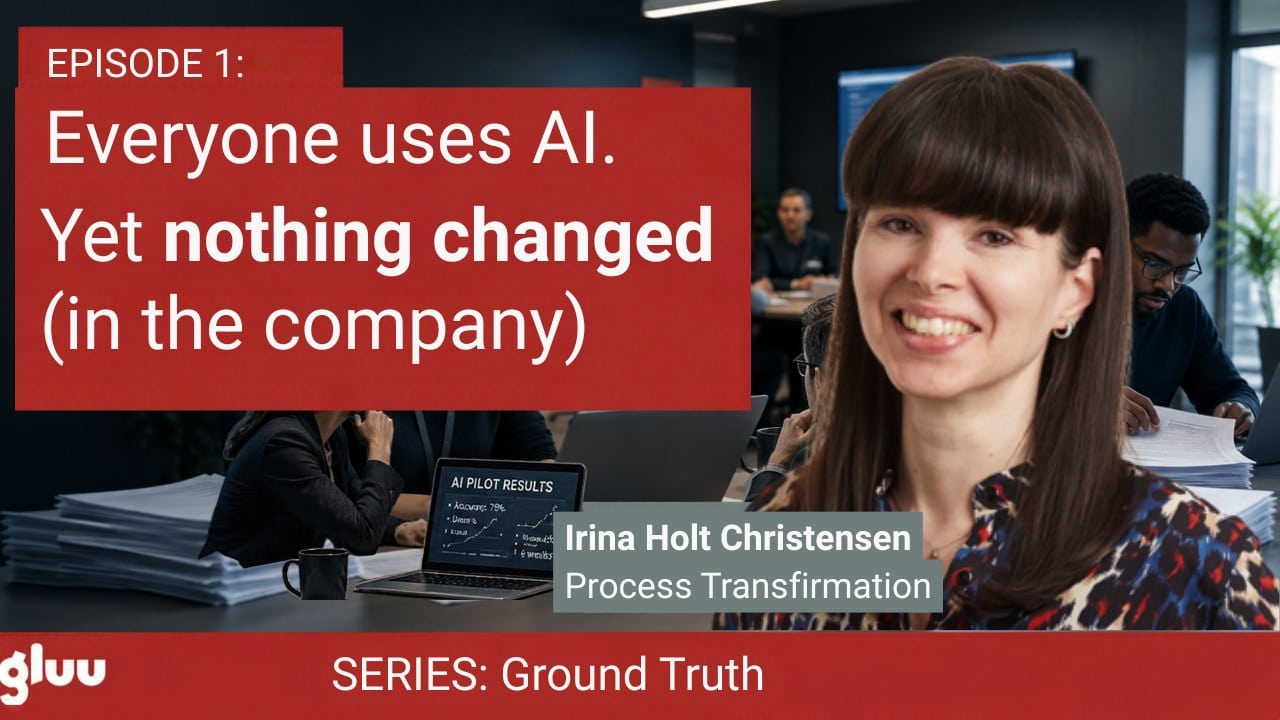
Your company has thousands of people using AI – so why can’t it say it works differently now?

In BCG’s June 2026 AI at Work survey, 42% of regular frontline users say AI saves them at least a full workday a week, yet 66% report limited or no guidance on what to do with that time. Individual use is rising while the way the organisation works stays the same.
The short answer: AI adoption measures how many people use a tool. Working differently means the operating model has changed around the technology – its processes, roles and decisions. Most organisations measure the first and do not plan for the second, and that gap sits behind many AI adoption challenges.
This article is based on a Ground Truth conversation with Irina Holt Christensen, who has run process excellence and cross-functional transformation work at Maersk Line, Novozymes and Sampension. Her advice in one line: “stop measuring individual adoption and look at the whole operating model change”.
Key takeaways
- Rising usage is not evidence of change. Ask what is different for the customer or the business.
- AI does not fix an unclear process. It makes the lack of clarity obvious.
- Treat a pilot as an operating model change from day one: a process owner, the people who do the work involved, and measurement before, during and after.
- The business owns AI readiness. IT builds, runs and secures; process management gives both a shared language.
- The most commonly missing piece is intent: what a piece of work is for, and where an agent may decide.
Watch the full 24-minute conversation from Gluu’s Ground Truth series below, or read on for the main points.
What is the difference between AI adoption and working differently?
| AI adoption | Working differently | |
|---|---|---|
| What it measures | How many people use the tool | What has changed in processes, roles and decisions |
| Level | Individual | Organisational capability |
| Typical evidence | Logins, usage, time saved | Change for the customer or the business |
| Who makes it happen | The team that builds the solution | The business, which decides staffing and how people spend their time |
Irina points to McKinsey research that shows the same gap: 80% of people say AI has made them more productive individually, but fewer, around 37% by her account, see an effect on the company’s results.
Irina’s warning sign is simple: usage goes up, but the processes stay the same. The benefits materialise, she says, when you also change how the team is staffed and how people spend their time – and those decisions rarely sit with the people who build the solutions.
“Our processes have been anchored from top to bottom in the group”. Read case
Camilla Larsen, Sr. Process Manager, Norlys
Why do pilots work and rollouts stall?
“When a pilot works, then the real change starts,” Irina says, because the process, the roles and the ownership now have to change for everyone else. A pilot usually has a motivated team that chose to take part and someone following it every day. Afterwards, the solution is handed to a team that simply does the work. In one AI pilot she worked on, customer calls were transcribed and summarised, and most advisors said the summaries helped them do their job better. That, she says, “was the easy part to show”.
What makes a pilot succeed is settled early: the people who do the job are involved, the process has an owner from the pilot phase, and success is measured before, during and after.

“Treating it as an operating model change from the beginning, where technology is the smaller part and all the other elements are even more important.”
Irina Holt Christensen, Process Transformation Leader
She saw the same pattern before AI. In a global transformation that affected 100,000 people, with around 1,000 people in new roles, go-live was the visible achievement. “But the real change came afterwards,” through hypercare, a new operating model and continuous improvement of it.
What does AI reveal about how work really runs?
AI shows very quickly whether an organisation is clear about its own processes, because, as she puts it, “AI works from what you give it”. Her line is that “most execution problems are clarity problems” and “AI just makes them more visible”. Irina points to three things that sound simple but usually take a long time to settle: the process itself, who owns it (and what owning it means), and handovers.
“If the process isn’t clear then AI won’t fix that. It will just make it obvious.”
Irina Holt Christensen, Process Transformation Leader
With handovers, she always starts by agreeing what a complete handover is, because nothing can be measured before that. Put AI on a handover without a definition and it works from whatever you give it – and “gives you an answer that looks confident that is not necessarily the right answer”.
This links to a wider test: can two people in your organisation describe the same best practice and mean the same thing? “Usually not,” she says. Ask them to write down what they do and they find they think they do the same thing, but they don’t. AI working from different versions of the same process will give you different versions of the answer.
Is this just change management?
Partly. Give people a new tool and wait, Irina says, and they will use it in their own way; after a while each of those versions becomes the as-is. Change management is part of the answer, including the discipline to stop things that are not working – which does not happen by itself and needs governance on who says stop. But it works best as part of a bigger operating model change, where you decide the new ways of working, who owns them and how they are measured.
Does regulation make this easier or harder?
Irina’s answer is that it is “easier on paper but harder in reality”. Regulated companies already document who decides what, with controls, approvals and governance – exactly what AI needs. The problem comes when the documentation does not reflect what people actually do day to day. And with AI agents taking decisions, regulation raises the bar: you need to know who owns the outcome when it is wrong and how to explain a decision to a customer or a regulator.
Who owns AI readiness?
The business, in Irina’s view: “the business has to own it.” It has to own how teams are staffed, what people spend their day on, which work disappears and who owns the outcome. IT builds, runs and secures the technology, which is a big job in itself; the risk is that IT ends up owning AI because it owns the tools. Process management sits between the two and makes the end-to-end process, handovers and decisions clear enough that IT and the business can decide about the same thing. See also process owner and hand-off.
What should a new process leader do first?
- Pick one end-to-end process where the value is clear, cross-functional and handover-heavy.
- Go through it with the people who run it.
- Find the owner. If nobody raises a hand, that is the first piece of work.
- Measure where you are and agree what good looks like.
- Ask which work should disappear, what can be automated, what AI can support and what stays with people.
- Plan for success: roles, governance and data will need to move with it.
If you want to try this on one process, you can start a free trial of Gluu below.
Gluu free 30-day trial. No credit card required. Start from €24 / year.
What is most often missing: prompt, context or intent?
The prompt, context and intent framing comes from AI thinker Nate B. Jones (see what intent engineering means for AI leaders). Irina’s answer is intent. Many organisations have trained people in prompting and started connecting AI to their documents and data, but few have decided what a piece of work is actually for: where an agent may take a decision, who owns the outcome and how work moves between people and AI. She calls that a leadership decision. Any process where a decision has a consequence for the customer that cannot be undone, she adds, should never run unsupervised.
“From what I see at least very few have decided what a piece of work is actually for.”
Irina Holt Christensen, Process Transformation Leader
More from Ground Truth Season 1: why AI pilots fail to scale (with Michael Hansen), where an organisation’s intent actually lives (with Etienne Venter) and why AI in ERP projects makes unclarity faster (with Henrik Hasselbalch).
FAQ – AI adoption and operating model change
Adoption is how many people use AI. An operating model change is a change to processes, roles and decisions around the technology. Only the second shows up for customers or the business.
Pilots have motivated teams and daily attention. Scaling requires the process, roles and ownership to change for everyone else, and that has to be planned from the start.
According to Irina Holt Christensen, the business. IT builds and secures the technology, and process management provides the shared language between them.
Change management is part of the answer, including stopping what is not working, but it works best inside a wider operating model change.
Treat it as an operating model change and make the person who can change how work is organised responsible for the outcome before rolling out anything else.
Any process where a decision has a consequence for the customer that cannot be undone.