Digital Transformation Business Process Management

Digital transformation can feel like a race to buy tools. Yet many teams still struggle with slow approvals, unclear handoffs, and “who owns this?” questions. So what’s missing? In most cases, it’s a process foundation.
Digital transformation business process management is possibly your search query and a bit of a mouthful. However, I choose to interpret it as your seach for the practical way to connect new technology with the way work actually happens. Because when processes are visible, owned, and improved on purpose, technology becomes an accelerator instead of another layer of complexity.
In this guide, I will do my best to address your seach intent by conveying what BPM means in a digital transformation context, why it matters, and how to apply it with real examples. Besides that, you’ll see how Gluu supports process-led transformation with people-friendly BPM software.
What Is BPM in Digital Transformation?
BPM (Business Process Management) is a way to design, run, measure, and improve business processes end to end. In digital transformation, BPM becomes the “operating system” for change. It gives you shared process language, clear ownership, and a repeatable method to improve how work flows across teams and systems.
Wondering why that matters? Because digital transformation is rarely one department’s job. It stretches across finance, HR, IT, operations, and customer-facing teams. Therefore, you need a cross-functional approach that can handle handoffs, exceptions, and governance without turning everything into meetings.
If you want a deeper dive, start with Business process management. It explains BPM as a management discipline, not just a software category.
BPM vs. workflow automation vs. digital adoption
It’s easy to mix these up. However, they solve different problems.
- Workflow automation speeds up steps (routing, reminders, validations).
- Digital adoption helps users learn tools (in-app guidance, training, walkthroughs).
- BPM aligns the end-to-end process: roles, rules, handoffs, measurement, and continuous improvement.
Automation is powerful, but it can also automate confusion. BPM reduces that risk by making the process explicit first. Most importantly, it clarifies what “good” looks like, so the technology supports the right behavior.
Why BPM matters for Digital Transformation
Digital transformation often promises faster delivery, better customer experience, and smarter decisions. Yet those benefits depend on day-to-day execution. BPM helps because it turns strategy into repeatable work.
- Higher efficiency because bottlenecks and rework become visible.
- Fewer errors because steps, inputs, and decision rules are clear.
- Faster time-to-market because handoffs are standardized and exceptions are handled consistently.
- Better collaboration because roles and responsibilities are defined across departments.
- More customer-centric processes because journeys can be designed around outcomes, not org charts.
What about modern tech like AI, cloud, RPA, and analytics? BPM makes them more effective by defining where they fit and what they should improve. Besides that, BPM helps you avoid “tool sprawl” by connecting solutions back to measurable process outcomes.
Top areas & frameworks for BPM-enabled Digital Transformation
Many frameworks exist, but the most useful ones are simple enough to guide decisions. Below are three practical lenses you can use—without turning transformation into theory.
The 5 main areas: People, Process, Technology, Data, Governance
Successful transformation balances five areas:
- People: roles, skills, adoption, and daily behaviors.
- Process: flow, handoffs, exceptions, and standards.
- Technology: platforms, integrations, automation, AI.
- Data: definitions, quality, access, and reporting.
- Governance: ownership, change control, KPIs, and continuous improvement.
BPM touches all five. It clarifies roles for people, defines the process, identifies tech needs, specifies data inputs/outputs, and sets governance for change. Therefore, BPM becomes the glue that keeps transformation coherent.
Governance is a key enabler. To dive deeper into this I would recommend our free Gluu Academy lesson on this topic:
The 4 D’s of digital transformation: Discover, Design, Develop, Deploy
These four steps work well when you want momentum:
- Discover: map the real “as-is” flow and pain points.
- Design: create a future-state process with clear decision rules.
- Develop: build automation, integrations, and guidance where it helps.
- Deploy: roll out with training, measurement, and a feedback loop.
Sounds straightforward, right? The hidden challenge is governance. Without ownership, changes drift and old habits return. BPM reduces that risk by creating a standard way to update processes and communicate improvements.
The 7 pillars: strategy, culture, operations, tech, data, customer experience, innovation
Different lists exist, but these seven pillars are a useful checklist. BPM strengthens each one by turning goals into measurable operational changes. Most importantly, it prevents “innovation theater” by grounding initiatives in real workflows and outcomes.
If you’re evaluating platforms, explore the broader tools and capabilities that support process-led change.
BPM-driven frameworks for value-led transformation
Value-led transformation is simple: improve what matters, measure it, and keep improving. BPM supports this with practical building blocks:
- Process mapping & optimization to expose handoffs and remove waste.
- Automation & AI integration to reduce manual work and speed decisions.
- KPI tracking to prove impact and spot new bottlenecks.
- Low-code/no-code workflows to adapt quickly as needs change.
- Alignment to business goals so improvements don’t become disconnected projects.
Need a practical starting point? Use process mapping to get end-to-end visibility before you automate anything.
Practical Digital Transformation Business Process Management examples
Examples make BPM feel real. Below are common use cases where BPM creates better outcomes than “just adding a workflow.”
Finance: AI-powered invoice approval
Invoice approval often breaks down due to missing data, unclear exception rules, and too many approval layers. BPM helps by defining the end-to-end process, including who can approve what, which exceptions require escalation, and what “complete” input looks like. Then AI can classify invoices and route them faster. As a result, cycle time drops without increasing risk.
HR: employee onboarding automation
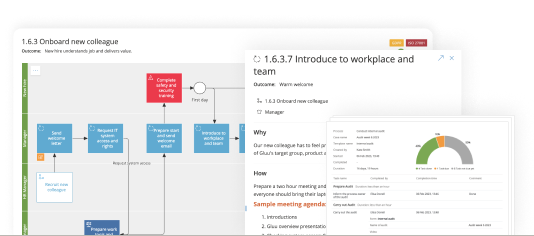
Onboarding crosses HR, IT, managers, and sometimes compliance. So where do delays happen? Usually in handoffs and unclear responsibilities. BPM standardizes the checklist, assigns ownership, and ensures the right guidance reaches the right role at the right time. For onboarding inspiration, see How to ensure a good employee onboarding process.

Customer service: complaint handling & SLA optimization
Complaint processes fail when exceptions are handled differently depending on who is working the case. BPM defines decision gates, standard responses, escalation rules, and measurement (like time-to-resolution). Besides that, it enables clear service ownership so customers don’t bounce between teams.
Operations: supply chain & logistics optimization
Supply chain work is full of exceptions—late deliveries, out-of-stock items, and changing demand. BPM helps by making exception handling consistent, measurable, and trainable. Therefore, teams spend less time firefighting and more time improving root causes.
Want a real-world example of BPM supporting transformation at scale? Read how a large retailer approached change: PEPKOR Selects Gluu as BPM Partner to Transform their Retail Execution Platform.
Steps to Implement BPM for Digital Transformation
How do you move from intention to execution? A simple, repeatable rollout reduces risk and builds trust.
- Audit and map current processes: capture the real flow, including workarounds.
- Find inefficiencies and automation opportunities: look for delays, rework, and unclear decisions.
- Design future-state workflows: simplify handoffs and define exception rules.
- Pilot, monitor, and optimize: measure impact before scaling across teams.
- Align leadership and culture: make ownership clear and support adoption with role-based guidance.
Are you tempted to start with a platform selection? That’s normal. But it’s usually smarter to start with one or two high-impact processes, prove value, and then scale your BPM approach. Most importantly, pick a process where results matter and data exists to measure change.
Common Challenges in BPM for Digital Transformation
Even strong teams hit predictable obstacles. The good news is that each one has a practical response.
- Resistance to change: involve frontline users early and show quick wins.
- Legacy system integration: start with the few integrations that unlock flow.
- Data and process silos: define shared inputs/outputs and standard ownership.
- Scalability and governance: create a change loop so updates don’t become chaos.
- Employee adoption and training: keep guidance role-based and easy to access.
Here’s a helpful question to ask: “If a key person is away, can the process still run well?” If the answer is no, BPM is your path to stability and scale.
Measuring success of Digital Transformation Business Process Management
Measurement is where many initiatives fade. So keep it simple: choose a few metrics that show execution quality and business impact.
- Operational efficiency: cycle time, throughput, backlog, cost per case.
- Customer experience: time-to-resolution, complaint rate, CSAT/NPS trends.
- Employee productivity: fewer handoffs, less searching, fewer repeated questions.
- Cost savings and ROI: reduced rework, fewer escalations, better compliance outcomes.
- Digital adoption KPIs: usage of new workflows, completion rates, exception handling quality.
Besides that, track “time to improve.” If it takes months to update a process, transformation slows down. BPM creates the governance rhythm that keeps change fast and controlled.
Gluu’s role in supporting Digital Transformation Business Process Management
Gluu helps teams connect people, tools, and processes at scale. That matters because transformation succeeds when execution becomes consistent and improvement becomes routine.
Gluu supports process-led transformation with capabilities that help you:
- Create shared process visibility so teams understand the end-to-end flow.
- Assign ownership and governance so changes are controlled and measurable.
- Connect processes to daily work with guidance, tasks, and structured execution.
- Track KPIs and improvements so progress stays visible and continuous.
If you’re comparing platforms, start here: BPM software selection. It’s a practical way to think about what you actually need—based on outcomes, not buzzwords.
Try Gluu for free
Sign up for a 30-day trial.
No credit card required.
FAQ – Digital transformation business process management
What is BPM in digital transformation?
BPM in digital transformation is the discipline of designing, running, measuring, and improving processes end to end while adopting new technology. It provides visibility, governance, and ownership so tools like AI, automation, and analytics improve real workflows instead of creating new silos.
What are the 5 main areas of digital transformation?
A practical set of five areas is: People, Process, Technology, Data, and Governance. Most importantly, BPM supports all five by clarifying roles, defining the workflow, guiding tech choices, standardizing data inputs/outputs, and creating a repeatable change cycle.
What are the 4 D’s of digital transformation?
The 4 D’s are Discover, Design, Develop, and Deploy. Discover maps the current reality, Design defines the future state, Develop builds enabling solutions, and Deploy rolls out with measurement and adoption. Because BPM supports governance, it helps you repeat the cycle and keep improving.
What are the 7 pillars of digital transformation?
A useful seven-pillar view includes: strategy, culture, operations, technology, data, customer experience, and innovation. BPM strengthens these pillars by turning strategic goals into measurable operational change and by keeping improvements aligned across teams.