
Business Process Management

Business Process Management (BPM) is a methodology to analyze, optimize, and manage business processes so work becomes faster, more reliable, and easier to change. In other words, BPM turns “this is how we do it” into a shared, measurable way of working you can improve—without reinventing the wheel every quarter.
Why does that matter? Because efficiency, performance, and digital transformation business process management all depend on how work flows across people and systems. If the process is unclear, new software simply digitizes confusion. When the process is owned and continuously improved, technology finally delivers the productivity gains it promised.
“If you automate a chaos, you’ll just get more chaos.“
– unknown
What Is Business Process Management?
Business Process Management is a structured discipline for improving end-to-end processes—across roles, departments, and systems. Gartner defines BPM as a management discipline that uses a set of methods to discover, model, analyze, measure, improve, optimize, and automate business processes.
Practically, BPM combines three things: (1) a clear description of how work should run, (2) support for executing that work in daily operations, and (3) a feedback loop that keeps improving it. That last part is critical. It turns BPM into a continuous improvement practice—not a one-time “process mapping project.”
BPM vs. task management and project management
It helps to separate BPM from nearby concepts so you pick the right tool and approach:
- Task management organizes individual to-dos (who does what by when). It’s useful for coordination. However, it rarely clarifies the end-to-end flow, decision rules, or handoffs—so improvement stays local instead of systemic.
- Project management governs a temporary initiative with a start and finish (for example, implementing a new system). BPM focuses on repeatable operational work—the activities you must run consistently after the project ends.
Because BPM treats improvement as ongoing, it fits naturally with continuous improvement approaches. You iterate: learn from performance, update the process, communicate the change, and repeat. Over time, small improvements compound into major operational gains.
Still unsure how to separate the two? Read Why your project is really a process (and why you should care) 👈
Why BPM Matters for Businesses
BPM matters because it makes work visible and therefore manageable. When teams can see the flow, they can reduce friction, improve outcomes, and scale without relying on tribal knowledge.
- Improves efficiency and performance: Clear steps and fewer handoffs reduce delays, rework, and escalation noise.
- Enables agility: When the “best known way of working” is documented and governed, changing it becomes faster—and less risky.
- Increases transparency and accountability: Ownership is explicit, status is easier to track, and the organization avoids “process orphans.”
- Improves employee and customer experience: People spend less time guessing, searching, and asking around—and customers get more predictable outcomes.
- Supports scalable growth: Standardized processes make onboarding, expansion, and compliance easier—because expectations and controls are clear.
“The value from process work is now very clear to the entire group.”
Julie Jensen, Process Consultant, Norlys (read case)
In other words: when roles and ownership are explicit, processes connect to daily execution, and improvements are captured continuously, BPM becomes visible value—rather than another internal initiative.
How Does Business Process Management Work?
BPM is often described as a five-stage lifecycle. You can apply it to one workflow or scale it across a portfolio. Either way, the stages provide structure while still supporting continuous improvement.
- Design – Define the outcome, who the process serves, and what “success” looks like. Clarify ownership and the main milestones so the process has a clear purpose.
- Model – Create a visual representation of the workflow: roles, steps, decisions, handoffs, and exceptions. The goal is shared understanding, not artistic perfection.
- Execute – Implement the process in real operations. Publish it where people work, make responsibilities explicit, and provide work instructions so “doing it right” is easy.
- Monitor – Track performance and detect bottlenecks. Combine data (cycle time, backlog, error rates) with feedback from the people doing the work so issues surface early.
- Optimize – Improve performance based on evidence. Simplify steps, reduce handoffs, tighten controls where needed, and communicate updates so the new standard actually sticks.
If you want a simple rule of thumb: design and model for clarity, execute for adoption, and monitor + optimize for impact. When those parts work together, BPM becomes an operating rhythm.
Types of Business Process Management
Not all processes behave the same. Some are mostly system-driven. Others rely on human judgment and approvals. A third category revolves around documents and evidence. These BPM types help you choose the right approach—and the right mix of tools.
Integration-centric BPM
Integration-centric BPM has low human involvement. The main value comes from integrating systems through APIs and connectors so data moves without manual copying. Typical examples include synchronizing ERP, CRM, and finance steps where volume is high and rules are stable.
Human-centric BPM
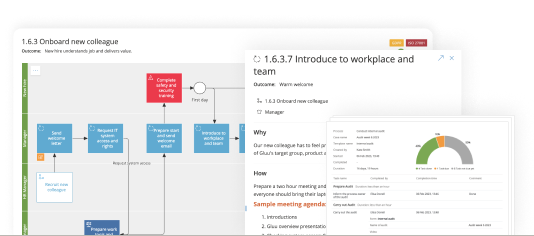
Human-centric BPM supports processes where people make decisions, request approvals, and handle exceptions—think onboarding approvals, change requests, or customer escalations. Here, adoption is everything. A user-friendly interface, clear responsibilities, and contextual guidance often matter more than advanced automation.
Below is an example of human-centric BPM helps staff to a ‘common way of working’:
Document-centric BPM
Document-centric BPM centers on document-driven workflows such as contracts, purchase orders, policies, and audit evidence. The focus is on routing, approvals, traceability, and version control—so the right people sign off and the right records can be found later.
In practice, many organizations blend all three: they keep humans in control of approvals and exceptions, automate stable steps, and ensure documents and evidence are governed. The best BPM approach is usually the one your teams will actually use—and improve over time.
Business Process Management Methodologies and Approaches
BPM isn’t a competing “philosophy” to popular improvement methods. Instead, it often acts as the system that operationalizes them—so improvements become repeatable and scalable.
- Lean: Focuses on removing waste (waiting, rework, unnecessary steps) to improve flow and speed.
- Six Sigma: Reduces variation and defects through measurement, root cause analysis, and control.
- Continuous improvement: Builds a culture of frequent, small changes that compound into big gains over time.
Where BPM adds unique value is that it connects improvements to the day-to-day execution of work. A Lean workshop can produce a better “to-be” process. BPM makes sure that process is published, owned, followed, measured, and continuously improved—rather than forgotten in a slide deck.
This is also where business process management tools make a difference. In Gluu, organizations typically combine:
- Process mapping that business users can understand—linked to roles, responsibilities, and work instructions.
- Workflow automation for approvals, routing, and human-centric task execution (and integrations when needed).
- Dashboards and transparency that show what’s happening, where work is stuck, and who owns the next step.
- Continuous improvement features that capture feedback and change requests in context, with approvals and version control.
How is this different from diagram tools or generic workflow apps? Diagram tools are excellent for drawing. However, they rarely support ownership, engagement, and governed change. Generic workflow tools can automate steps, yet they often struggle to provide an understandable process overview and a controlled process repository for the wider organization.
Read more about tooling here: Business process management software 👈
Real-world Business Process Management Use Cases
BPM is most valuable where work crosses roles and systems—or where exceptions create friction. Here are common use cases that benefit from a structured BPM approach:
Customer service workflow automation
Standardize case handling, triage rules, and escalation paths. When agents follow a shared flow and ownership is clear, response times improve and quality becomes more consistent—especially when demand spikes.
Looking for process examples? Visit Customer Support processes with Gluu
HR onboarding/offboarding and approvals
Coordinate HR, IT, and managers with clear approvals and handoffs so onboarding becomes predictable and offboarding becomes safer. A BPM-driven approach reduces missed steps and speeds up time-to-productivity.
Looking for process examples? Visit Human Resource processes with Gluu
Finance: standardizing purchase orders
Define thresholds, approval chains, and documentation requirements. This reduces late approvals, improves spend control, and makes audit trails easier to produce—without adding unnecessary bureaucracy.
Looking for process examples? Visit Finance & Accounting processes with Gluu
Order fulfillment: improving operational efficiency
Align sales, operations, warehouse, and billing so handoffs are clear and exceptions are handled consistently. Once the flow is stable, integrations and automation can remove manual friction.
Looking for process examples? Visit Production and Distribution Processes with Gluu
Content distribution: streamlining media workflows
Speed up reviews, approvals, and publishing by clarifying steps and responsibilities across stakeholders. This is especially useful when compliance checks or brand approvals are required before release.
👉 Want real examples? Browse Customer Cases to see real BPM use cases from different industries.
Business Process Management and Digital Transformation
Digital transformation often fails for a simple reason: teams automate broken or unclear workflows. BPM prevents that by making processes explicit before (and during) digitization. As a result, systems support the business instead of forcing workarounds.
When BPM supports digital transformation, you typically see three improvements at once:
- Better coordination across people and systems: Roles, steps, and handoffs are clear, and integrations are built around a known flow.
- Stronger information flow: Employees find the right process guidance, work instructions, and templates in context—so decisions are faster and more consistent.
- Safer change: Governance and version control make it easier to update processes without losing compliance or creating chaos.
In short: BPM turns transformation from a “tool rollout” into a repeatable way to improve operations—step by step, with clear ownership and measurable outcomes.
Try Gluu for free
Sign up for a 30-day trial.
No credit card required.
FAQ – Business Process Management
Business process management means improving how recurring work runs end-to-end by defining processes clearly, assigning ownership, supporting execution, measuring performance, and continuously optimizing. It’s both a method (how you improve) and a management practice (how you keep processes current and governed).
A common BPM lifecycle has five stages: Design (define outcome, ownership, and milestones), Model (visualize the workflow), Execute (implement and run it), Monitor (track performance and bottlenecks), and Optimize (improve the process based on data and feedback).
These levels help you navigate from strategy to daily work: L1 describes the high-level value chain, L2 shows end-to-end processes, L3 breaks them into sub-processes, and L4 contains practical procedures and work instructions. The goal is fast navigation: overview when you need it, detail when you must execute.
Examples include onboarding/offboarding with approvals, purchase order workflows with thresholds and documentation, customer service case routing and escalation, order fulfillment handoffs between operations and billing, and content publishing flows that coordinate reviews and compliance checks.